There is something quietly remarkable about watching a simple family email transform into a trusted source of political analysis for tens of thousands of readers. In an era when everyone seems to be shouting for attention on social media, cable news channels compete for the most sensational headlines, and political discourse often feels like a battlefield, Robert Hubbell has built something different. He has created a space where people can actually think.
I first came across Robert Hubbell’s work during one of those late-night scrolling sessions that many of us have fallen into since 2016. You know the ones, where you are trying to make sense of yet another chaotic news cycle, feeling overwhelmed by the sheer volume of information and opinion coming at you from every direction. A friend had forwarded me one of his newsletters with a simple note: “This guy actually makes me feel better about things.” That was enough to get me interested.
What I found was something rare in today’s political media landscape: a voice that was calm, measured, deeply informed, and genuinely hopeful. Not the fake optimism that ignores real problems, but a grounded hope that comes from actually understanding how systems work and believing that they can be improved. That voice belonged to Robert Hubbell, a retired trial attorney from Los Angeles who never set out to become a political commentator but found himself becoming exactly that.
Early Life and Education: The Making of an Analytical Mind
Robert B. Hubbell was born on April 26, 1956, in Los Angeles, California. Growing up in the sprawling metropolis of LA during the 1960s and 1970s, he came of age amid significant social and political change in America. The Vietnam War was winding down, the civil rights movement had transformed the country, and Watergate had shaken public trust in government institutions. These were formative years for anyone paying attention to how power and justice work in American society.
Hubbell pursued his undergraduate education at Loyola Marymount University, earning his Bachelor of Arts degree in 1978. This was a school with a strong Jesuit tradition of intellectual rigor and social consciousness. This environment encourages students to think critically about the world around them and to consider their responsibility to society. That educational foundation would prove important later when Hubbell began writing about civic duty and democratic participation.
After completing his undergraduate studies, Hubbell enrolled at Loyola University Los Angeles School of Law, where he earned his Juris Doctor in 1981. Law school is where Hubbell developed the analytical skills that would define both his legal career and, decades later, his political commentary. Legal training teaches you to read carefully, to distinguish between facts and opinions, to identify logical fallacies, and to build arguments based on evidence rather than emotion. These are the same skills that make his newsletter so valuable today.
During his time in law school, Hubbell was active with the Loyola Law Review from 1980 to 1981, demonstrating his early interest in legal scholarship and writing. He also served as a Law Clerk to the Honorable Stephen Reinhardt of the United States Court of Appeals for the Ninth Circuit, one of the most influential appellate courts in the country. This experience gave him an inside view of how the judicial system actually works, not just how it is portrayed in movies or television shows.
Three Decades in the Courtroom: Building Expertise
Robert Hubbell was admitted to the California State Bar in 1981, the same year he graduated from law school. This began a thirty-plus-year career as a trial attorney, working on some of the most complex and challenging cases in the legal system. His early career was spent at Heller Ehrman White & McAuliffe, a prestigious law firm where he specialized in professional liability litigation and insurance coverage litigation. These are not simple areas of law. They require understanding intricate regulations, analyzing detailed contracts, and making sense of complicated financial arrangements.
Later in his career, Hubbell joined Morrison & Foerster LLP, one of the largest and most respected law firms in the world. There, he focused on securities litigation, representing clients in cases involving financial fraud, regulatory compliance, and complex business disputes. Securities litigation is particularly demanding because it sits at the intersection of law, finance, and public policy. It requires understanding not just legal statutes but also how markets function, how corporations operate, and how government agencies regulate economic activity.
Hubbell’s excellence in his field was recognized through his selection to Super Lawyers in 2004 and again from 2014 through 2017. Super Lawyers is a rating service that identifies outstanding lawyers who have attained a high degree of peer recognition and professional achievement. The selection process is rigorous, involving independent research, peer nominations, and evaluations. Being named a Super Lawyer is not something you can buy or market your way into; it reflects genuine respect from colleagues who understand the quality of your work.
Over the course of his legal career, Hubbell tried numerous cases to verdict, developing the ability to present complex information in ways that judges and juries could understand. He learned how to read people, spot inconsistencies in testimony, and build narratives that made sense of complicated facts. These skills, honed over decades in courtrooms, would prove surprisingly transferable when he began analyzing political events years later.
What strikes me as particularly valuable about Hubbell’s legal background is that it taught him to be comfortable with complexity. In law, there are rarely simple answers. Every case involves multiple parties with competing interests, conflicting interpretations of facts, and legitimate arguments on different sides. Hubbell learned to wade through this complexity without becoming cynical or dismissive. He learned that you can understand how systems fail without abandoning your belief that they can be improved. This perspective is evident in everything he writes today.
The Birth of Today’s Edition: From Family Email to Political Platform
The story of how Robert Hubbell became a political commentator begins with the 2016 United States presidential election. Like many Americans, Hubbell watched the results with a mixture of surprise and concern. The outcome was not what most pollsters or pundits had predicted, leaving millions of people trying to process what had happened and what it meant for the country.
For Hubbell, the response was personal and immediate. As a father and husband, he felt a responsibility to help his family make sense of the new political reality. In January 2017, he wrote his first newsletter. It was not intended for public consumption. It was simply an email to his family members, sharing his thoughts on the news of the day, offering perspective on what was happening in Washington, and trying to provide a sense of hope during a confusing time.
Hubbell has described that first issue as his effort to provide “hope and perspective” to the people he loved most. He was not trying to build an audience or establish himself as a thought leader. He was just trying to help his family navigate a difficult moment in American history. There is something genuinely touching about this origin story. It reminds us that sometimes the most meaningful communication comes from a place of care rather than ambition.
What happened next was entirely organic. Family members started sharing Hubbell’s emails with friends. Those friends shared them with their friends. Slowly but steadily, the distribution list grew. People were drawn to Hubbell’s calm, analytical voice at a time when so much political commentary felt hysterical or partisan. They appreciated that he seemed more interested in helping them understand what was happening than in telling them what to think.
By the time Hubbell moved his newsletter to Substack, a platform that allows writers to publish directly to subscribers, Today’s Edition had already developed a significant following. Today, the newsletter boasts approximately 80,000 subscribers, an impressive number for an independent publication that has never spent money on advertising or marketing. These subscribers are not just passive readers; they have become a community of “like-minded citizens devoted to preserving American democracy,” as Hubbell describes them.
The newsletter’s tagline is “A reflection on today’s news through the lens of hope.” This phrase captures what makes Hubbell’s approach distinctive. He is not a Pollyanna who ignores bad news or pretends that everything is fine. He acknowledges the very real threats to American democracy, the genuine challenges facing ordinary people, and the failures of political leaders. But he refuses to surrender to despair or cynicism. He believes that understanding what is happening is the first step toward changing it, and that clear, accurate information can empower people to engage more effectively in civic life.
Political Commentary Style and Philosophy
Reading Robert Hubbell’s newsletter regularly, you quickly notice several characteristics that set his work apart from typical political commentary. First, there is his respect for detail. Hubbell does not traffic in generalizations or sweeping statements. He reads the actual text of legislation, court decisions, and policy proposals. He looks at voting records and statistical data. When he makes an argument, he supports it with specific evidence that readers can verify for themselves.
This approach reflects his legal training. In a courtroom, you cannot simply assert things; you must prove them. Hubbell brings that same standard to his political analysis. When he writes about economic policy, he cites actual numbers. When he discusses legal cases, he explains the specific statutes and precedents involved. This can make his newsletters longer than typical opinion pieces, but it also makes them more valuable. You finish reading with a better understanding of the subject, not just a stronger opinion.
Second, Hubbell maintains a consistent focus on what might be called democratic fundamentals. He is interested in voting rights, the rule of law, the integrity of institutions, and the health of civic culture. While he certainly has political views and is open about them, his primary concern seems to be whether the systems that make self-government possible are functioning properly. This gives his work a steadiness that is refreshing in an environment where the news cycle changes every few hours.
Third, Hubbell has developed a distinctive voice that is both serious and accessible. He writes like a smart friend who happens to know a lot about law and politics, not like an academic lecturing from on high or a pundit performing for an audience. He uses humor occasionally, but never at the expense of the subject matter. He admits when he is uncertain about something or when the available information is incomplete. This intellectual honesty builds trust with readers.
One of Hubbell’s most significant contributions to political discourse has been his analysis of the Democratic Party’s relationship with working-class voters. Following the 2024 election, there was no shortage of commentary claiming that Democrats had “abandoned” or “lost touch with” working-class Americans. Hubbell challenged this narrative directly, arguing that it was factually wrong and politically corrosive.
In his analysis, Hubbell pointed out that virtually every policy promoted by the Democratic ticket in 2024 was designed to help middle-class, blue-collar, and working-poor Americans: childcare tax credits, earned income credits, lower prescription drug prices, protecting affordable healthcare, increasing the minimum wage, protecting unions, providing in-home care for elderly and homebound people, subsidizing first-time homebuyers, building affordable housing, student loan forgiveness, and prosecuting price gouging. The problem, he suggested, was not that Democrats had abandoned working-class voters on policy grounds, but that many working-class voters, particularly men, disagreed with Democratic positions on social issues like reproductive rights, LGBTQ rights, voting rights for Black citizens, and climate change.
This kind of analysis is characteristic of Hubbell’s approach. He does not simply accept conventional wisdom or repeat talking points. He examines the evidence, considers the logical implications, and presents conclusions that may challenge assumptions on all sides. His goal is not to win arguments but to help readers understand what is really happening.
Notable Commentary and Growing Influence
Over the years, Robert Hubbell has written about virtually every major political development in American life. His archives contain thoughtful analysis of Supreme Court decisions, legislative battles, election campaigns, and social movements. He has been particularly sharp in his critique of mainstream media coverage, arguing that too much political journalism prioritizes drama over substance and conflict over understanding.
Following the 2024 election, Hubbell’s commentary gained renewed attention as people sought to make sense of results that surprised many observers. His post-election analysis, which challenged the prevailing narrative about Democratic failures, was widely shared and discussed. He argued that the political commentariat’s immediate explanations for election outcomes were likely to be “spectacularly wrong,” citing historical patterns of post-election analysis that aged poorly.
Hubbell has also become a sought-after speaker for events focused on civic engagement and political understanding. He has spoken at temples, community centers, and political organizing meetings, always emphasizing the importance of staying informed, staying engaged, and maintaining hope even in difficult times. His livestreams on Substack, where he takes questions from readers, have become popular gatherings for his community of subscribers.
Media Bias/Fact Check, an organization that rates the reliability and bias of news sources, has evaluated Hubbell’s newsletter and found it to be generally reliable with a left-center bias. The site notes that Hubbell provides sourced information and makes distinctions between reporting and commentary. This kind of external validation matters in an era of widespread misinformation and declining trust in the media.
What is perhaps most significant about Hubbell’s influence is that it has been built entirely through the quality of his work. He has not had the backing of a major media organization, a television platform, or a marketing budget. He has simply written consistently excellent newsletters that respect his readers’ intelligence and help them make sense of a confusing world. In doing so, he has demonstrated that there is still an audience for thoughtful, substantive political analysis.
Why Robert Hubbell Matters in Today’s Media Landscape
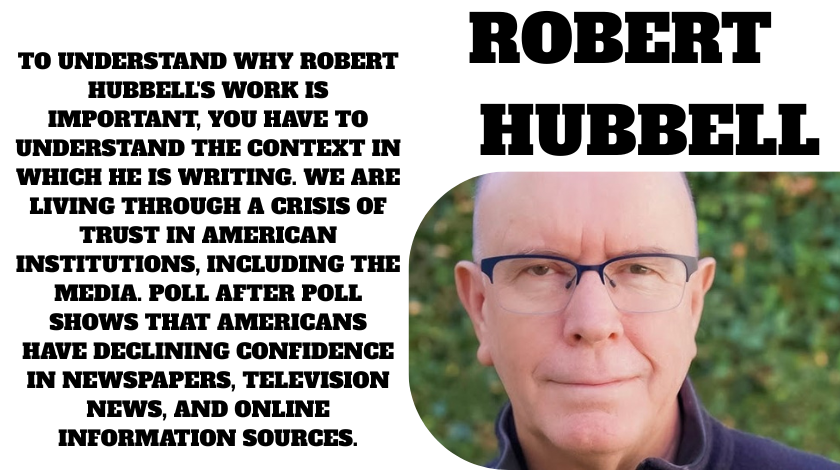
To understand why Robert Hubbell’s work is important, you have to understand the context in which he is writing. We are living through a crisis of trust in American institutions, including the media. Poll after poll shows that Americans have declining confidence in newspapers, television news, and online information sources. Part of this is due to the rise of partisan media outlets that prioritize confirming their audience’s existing beliefs over providing accurate information. Part of it is due to the economic pressures on journalism that have led to cost-cutting and a focus on click-generating sensationalism.
In this environment, independent voices like Hubbell serve a crucial function. They demonstrate that it is still possible to write about politics with integrity, to prioritize accuracy over speed, and to build a relationship with readers based on trust rather than manipulation. Hubbell’s newsletter is proof that there is a market for serious political analysis and that writers can make a living, or at least a meaningful contribution, by providing it.
Hubbell also represents a different model of political engagement than what we often see in public life. He is not a partisan warrior trying to destroy the other side. He is not a cynic who believes that nothing can be changed. He is not an entertainer treating politics as a spectator sport. He is a citizen who believes that understanding how government works is part of being a responsible member of a democracy, and who is trying to help other citizens develop that understanding.
For readers who feel overwhelmed by the noise of modern political media, Hubbell offers something valuable: a place to slow down and actually think. His newsletters take time to read, and they are worth that time. They do not provide the dopamine hit of outrage or the comfort of confirmation bias. Instead, they offer the deeper satisfaction of genuine understanding.
Conclusion
Robert Hubbell’s journey from Los Angeles trial attorney to influential political commentator is a reminder that expertise and integrity still matter in public life. In a media landscape dominated by sensationalism and partisan shouting, Hubbell has built a following by doing something radical: being careful, being honest, and being hopeful.
His Today’s Edition newsletter, which began as a simple email to family members in January 2017, has grown into a community of 80,000 subscribers who look to Hubbell for perspective on the news of the day. What they find is not just analysis but a model of civic engagement. Hubbell shows his readers that it is possible to be deeply concerned about the state of American democracy without surrendering to despair, and that understanding complex issues is the first step toward addressing them.
For anyone interested in political commentary that respects the reader’s intelligence, for anyone looking for analysis that is grounded in facts rather than driven by emotion, and for anyone who needs a reminder that hope is still possible even in difficult times, Robert Hubbell’s work is worth exploring. He has proven that one person, writing thoughtfully and consistently, can still make a difference in how we understand our world.
FAQ
Who is Robert Hubbell? Robert Hubbell is a retired trial attorney from Los Angeles who has become a prominent political commentator through his daily newsletter, Today’s Edition. He practiced law for over thirty years, specializing in securities litigation and professional liability cases, before turning to political writing in 2017.
What is Robert Hubbell’s educational background? Hubbell earned his Bachelor of Arts from Loyola Marymount University in 1978 and his Juris Doctor from Loyola University Los Angeles School of Law in 1981. He also served as a law clerk to Judge Stephen Reinhardt of the Ninth Circuit Court of Appeals.
When did Robert Hubbell start his newsletter? Hubbell wrote the first issue of Today’s Edition in January 2017, originally as an email to his family members following the 2016 presidential election. It was intended to provide hope and perspective during a confusing political moment.
How many subscribers does Today’s Edition have? Today’s Edition has approximately 80,000 subscribers on Substack. The newsletter has grown entirely through Word of mouth, without any advertising or marketing budget.
What is Robert Hubbell’s political perspective? Hubbell writes from a progressive perspective and is generally supportive of the Democratic Party, but his primary focus is on preserving democratic institutions and processes. He is known for his analytical approach that prioritizes facts and evidence over emotional reactions.
What topics does Robert Hubbell write about? Hubbell covers daily political news, Supreme Court decisions, legislative developments, election analysis, and media criticism. He is particularly known for his detailed analysis of policy issues and for challenging conventional political narratives.
Where can I read Robert Hubbell’s newsletter? Today’s Edition is published on Substack at roberthubbell.substack.com. Some content is available for free, while full access requires a paid subscription.
Has Robert Hubbell received any recognition for his work? Yes, Hubbell has been recognized by Media Bias/Fact Check for reliability and has been selected as a Super Lawyer multiple times during his legal career. His commentary has been widely shared and discussed in progressive political circles.
What makes Robert Hubbell’s commentary different from other political writers? Hubbell brings decades of legal training to his political analysis, emphasizing careful reading of source materials, attention to detail, and logical argumentation. He maintains a calm, hopeful tone even when discussing serious threats to democracy.
Is there a Wikipedia page for Robert Hubbell? As of this writing, Robert Hubbell does not have a dedicated Wikipedia page, though he is mentioned in various contexts related to political commentary and Substack writers. Much of the information about him comes from his Substack “About” page, interviews, and media coverage of his work.

